
%20(1).png)
Galaxy Watch Ultra 2 vs. Galaxy Watch Ultra: Technical Breakdown
In the highly competitive multisport smartwatch market, upgrading from the first-generation Galaxy Watch Ultra to the Galaxy Watch Ultra 2 marks a major technical milestone in 2026. Beyond subtle design tweaks, Samsung focuses on deep hardware optimization via a new SoC and full integration of Galaxy AI for real-time physiological tracking.
Architecture & Performance: The Leap with Snapdragon Wear Elite
In sports smartwatch engineering, the processor is the core pillar of thermal management and battery efficiency. For the Ultra 2, Samsung introduces the Snapdragon Wear Elite (SW6100) processor.
Built on a cutting-edge 3nm process, this SoC features a Penta-Core architecture clocked at 1.6 GHz and 1.5 GHz. This performance boost is paired with internal storage expanded to 64GB (around 50GB available to users).
This chip accelerates One UI 9 (based on Wear OS 7) while processing Galaxy AI metrics on-device. Data from the BioActive Sensor, such as FTP estimation or AGEs index, is computed instantly without cloud dependency.
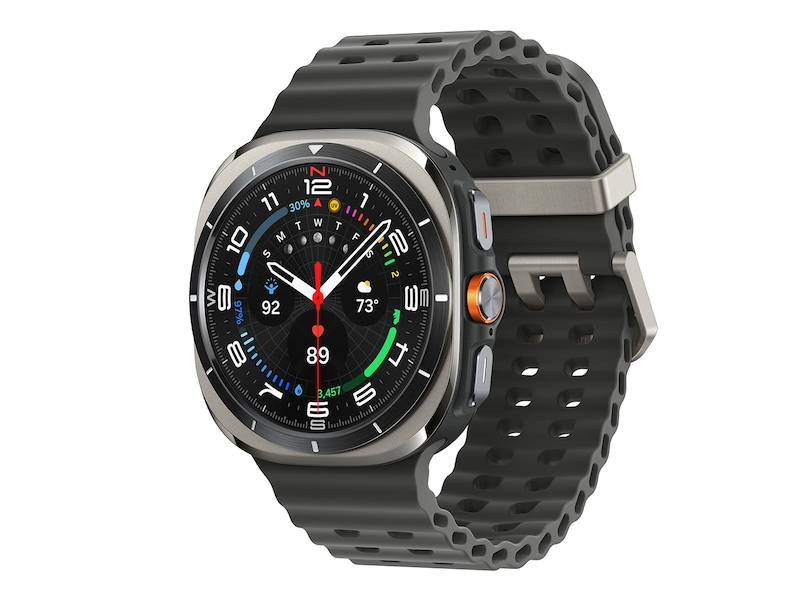
Enhanced Visibility and Outdoor Armor
For extreme environments, display legibility and structural durability are essential. The Ultra 2 maintains its rugged cushion design while introducing the Titanium Blue colorway.
The case frame combines Grade 4 Titanium on key target areas with Grade 2 Titanium and polymer to balance weight and durability.
| Feature | Galaxy Watch Ultra 2 Specs |
|---|---|
| Materials | Grade 4 (partial) & Grade 2 Titanium, polymer |
| Display Brightness | 3000 nits (Peak at 5000 nits in direct sunlight) |
| Screen Protection | Sapphire Crystal Glass |
| GPS | Dual-Frequency L1 + L5 |
| Durability | 10 ATM / IP68 / Military standard MIL-STD 810H |
The Dual-Frequency L1+L5 GPS delivers outstanding tracking accuracy in urban canyons or mountain trails. Certified to withstand temperatures from -20°C to 55°C and altitudes up to 9,000 meters, the watch effectively protects its health sensors.
Galaxy AI & Health: Precision Metabolic Tracking
Leveraging the BioActive Sensor and Galaxy AI algorithms, the Galaxy Watch Ultra 2 translates physiological signals into actionable health insights:
- AGEs Index (Advanced Glycation End-products): Metabolic health and biological aging tracking measured overnight.
- Energy Score: Daily score combining sleep quality and physical activity.
- Vascular Load (Labs): Experimental tracking of cardiovascular strain to prevent overtraining.
- Sleep Apnea Detection: Certified algorithm to spot signs of moderate-to-severe breathing obstructions.
For cyclists and triathletes, FTP (Functional Threshold Power) estimation now takes just 10 minutes of steady pedaling.
Battery Life and Power Management: Software Efficiency
The battery keeps its official 590 mAh capacity. Battery life gains stem entirely from the efficiency of the 3nm processor:
- Power Saving Mode: Up to 100 hours.
- Exercise Power Saving (Active GPS): Up to 48 hours (ideal for ultra-endurance events).
- Normal Daily Use (Always On Display): Up to 60 hours.
This optimization yields an estimated +35% power efficiency boost over the previous generation, ensuring uninterrupted tracking during long events.
Our Take: Which Model Should You Choose?
Priced in the premium segment at €749, the Galaxy Watch Ultra 2 targets demanding athletes and tech enthusiasts.
- For Galaxy Watch 4, 5, or 6 users: Upgrading to the Ultra 2 brings a massive leap in battery life, screen brightness, and GPS precision.
- For 1st-Gen Galaxy Watch Ultra owners: The upgrade is driven by 64GB storage, the 3000 nits display, and faster Galaxy AI responsiveness.
Our Verdict: The Galaxy Watch Ultra 2 stands out as the most powerful and complete smartwatch in Samsung's 2026 lineup.