
%20(1).png)
Philips Power Flosser 3000 Review: A Credible Alternative to Waterpik?
Philips Power Flosser 3000 Review: A Credible Alternative to Waterpik?
Interdental hygiene is no longer just a dental office recommendation; it has become the new playground for domestic Health-Tech. After decades of unchallenged dominance by historical leader Waterpik, Philips Sonicare finally launches a serious offensive with its Power Flosser 3000. This strategic shift from manual oral irrigation to a stationary countertop solution is not merely a matter of comfort; it aims to optimize clinical compliance by transforming a tedious chore into an efficient technological ritual.
Positioned as an entry-level premium device, the Power Flosser 3000 aims to dethrone the unshakeable Waterpik Aquarius by betting on sleek aesthetics and proprietary innovations. But is modern design enough to compensate for decades of ergonomic expertise?
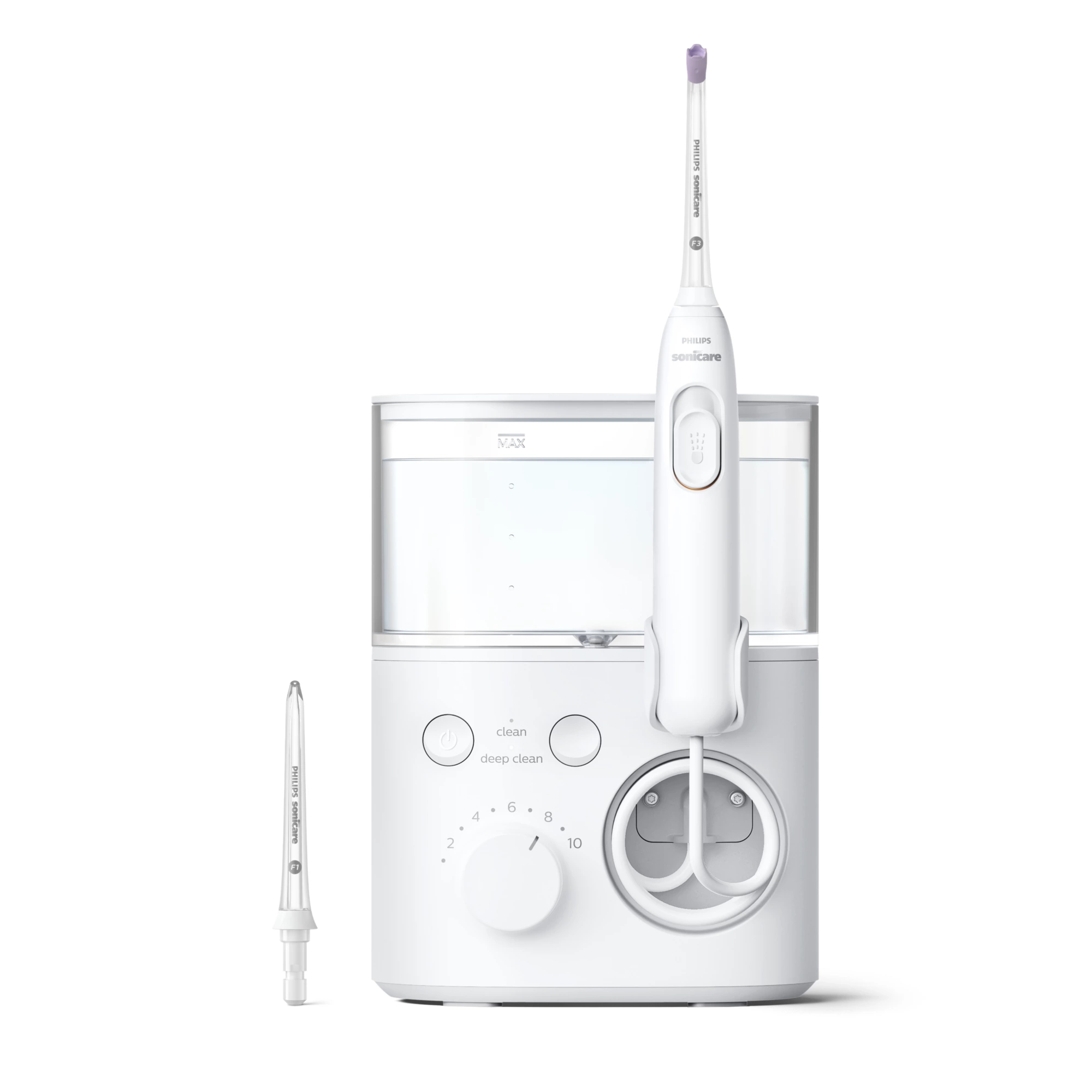
Design and Ergonomics: Premium Aesthetics vs Static Handling
When it comes to health smart appliances, countertop footprint is a major rejection factor. Philips understood this and offers a unit whose clean lines visually outperform the competition. The construction favors smooth surfaces, eliminating complex grooves—notorious dust traps and limescale accumulation zones—thereby simplifying daily cleaning maintenance.
Regarding space saving, Philips scores a decisive point: while the Waterpik Aquarius imposes a rear power cord protrusion that prevents placing the unit flush against the wall, the Power Flosser 3000 incorporates intelligent cable management underneath the unit. This detail allows a flush countertop integration.
However, real-world testing reveals flaws. Despite rubber feet, the unit has an annoying tendency to slide across the countertop when operating the control buttons. Furthermore, while the main base feels sturdy, the handle betrays material compromises: it feels light and hollow in hand, lacking the density expected from a Sonicare product.
Quad Stream Technology: The X-Shaped Water Jet Put to the Test
The technological heart of the device lies in its Quad Stream nozzle (F3). Unlike standard single-stream nozzles (F1) that project a sharp single jet, the F3 nozzle splits the water stream into a cross shape (X).
User Benefit Analysis: This diffusion covers a significantly broader surface area, drastically reducing the time required to floss the entire dentition. For orthodontic wearers (braces) or implant patients, this is a major benefit: the stream is less piercing but more enveloping, dislodging food debris around brackets with enhanced efficiency. Conversely, surgical irrigation purists may find the Quad Stream jet somewhat too diffuse compared to the standard F1 nozzle, which remains more precise for stubborn debris.
Pressure Power and Noise Differential
Customizing pressure settings is essential to respect gingival tissue integrity. The Power Flosser 3000 offers 10 pressure levels via a rotary dial. Unfortunately, Philips does not officially publish PSI ranges per level, but our testing shows the sweet spot lies between levels 6 and 7, delivering approximately 70-80 PSI—an ideal pressure for most users.
Quietness Has Its Limits: One of Philips main selling points is silent operation. Our measurements confirm a 20-decibel noise reduction compared to competitors, hovering around 52-54 dB. Caution is warranted, however: this discretion only holds true at level 1. As power is cranked up toward level 10, noise climbs to 73 dB, matching the usual racket of standard countertop flosser pumps.
Special mention goes to Pulse Wave mode (pacing guide), available exclusively in Deep Clean mode. This system emits tactile water pulses to pace the transition from one tooth to the next, preventing haphazard cleaning and ensuring complete 60-second oral coverage.
Capacity and Autonomy: Simplified Logistics
Care compliance depends on workflow smoothness. The 550 ml (18.6 oz) reservoir is sized to prevent unwanted refills midway through flossing.
- At maximum pressure setting: Expect approximately 1 minute 15 seconds of continuous water flow.
- At low pressure setting: Autonomy extends up to 5 minutes.
This capacity is sufficient for thorough cleaning without refilling, a key psychological factor to build a lasting daily habit. The reservoir is easily detachable for complete cleaning, a necessity to prevent bacterial growth.
Philips Power Flosser 3000 vs Waterpik Aquarius
Comparing against market leader Waterpik Aquarius (WP-660) is essential to evaluate this challenger.
| Features | Philips Power Flosser 3000 | Waterpik Aquarius (WP-660) |
|---|---|---|
| Pressure Levels | 10 settings | 10 settings |
| Reservoir Capacity | 550 ml | 650 ml |
| Nozzle Rotation | Fixed | 360 degrees |
| Height (with nozzle) | 29 cm | 29 cm |
| Manufacturer Warranty | 2 years | 3 years |
| Cord Storage | Underneath unit (Flush) | Rear Protrusion |
| Certification | ADA Accepted | ADA Accepted |
The Breaking Point: This is where Philips loses its ergonomic crown. On the Waterpik, you can rotate the nozzle 360° with your index finger during use to target lingual surfaces or behind molars. On the Philips, the nozzle tip is fixed. This forces awkward wrist and arm contortions, making access to hard-to-reach areas significantly less intuitive.
Total Cost of Ownership (TCO) Calculation
Analyzing Total Cost of Ownership (TCO) is essential. While the initial purchase price of the Philips is often attractive (around $80), replacement parts add up:
- Nozzle Replacement Cost: Approx. $7.50 per unit, 50% more expensive than Waterpik nozzles.
- Replacement Frequency: A positive note, Philips recommends replacement every 6 months (vs 3 months for some competitors), which softens the added cost.
- Preventive Maintenance: To preserve pump longevity, a monthly white vinegar flush is imperative to clear internal limescale, followed by a thorough fresh water rinse.
Our Verdict: Should You Buy the Power Flosser 3000?
The Philips Power Flosser 3000 is an aesthetic triumph that finally modernizes countertop oral irrigators. It is a sleek device that integrates seamlessly into contemporary bathrooms thanks to its flush design.
Strengths:
- Quad Stream Technology: Ideal for sensitive gums and orthodontic braces.
- Quiet Operation: Exceptionally silent at lower pressure settings.
- Cable Management: Best in class for saving countertop space.
- Maintenance: Nozzles replaced only every 6 months.
Weaknesses:
- Ergonomics: Fixed nozzle is a major design flaw.
- Stability: Base tends to slide across countertops during button activation.
- Handle Build Quality: Feels light and hollow.
- TCO: Expensive replacement nozzles.
Our Verdict: The Power Flosser 3000 is the ideal choice for users prioritizing low noise, modern aesthetics, and wide-coverage water streams. It is a beautiful health appliance. However, for pure manipulation ergonomics and surgical precision, the Waterpik Aquarius retains its edge thanks to its 360° rotating nozzle head. In either case, remember that consistent daily flossing is what truly prevents periodontal disease.