
%20(1).png)
Samsung Galaxy Ring Put to the Real Test: Analysis of the Core Feature
The Samsung Galaxy Ring marks a pivotal milestone in continuous biometric data acquisition within the Samsung ecosystem. Far from marketing promises, this device is technically defined by its miniaturization constraints and its ability to transform a passive data stream into actionable health insights. Beyond hardware performance, its strategic value lies in the integration of Galaxy AI without subscription fees, establishing a major competitive edge over legacy players despite critical concerns regarding hardware durability.
Technical Infrastructure: A Concentrated Array of Miniaturized Sensors
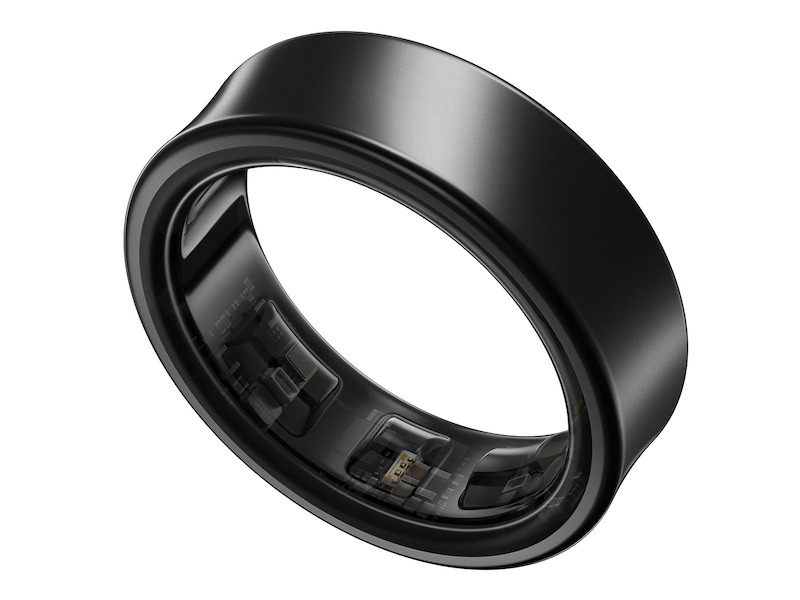
Transitioning from a watch to a ring form factor requires precision engineering to ensure passive diagnostic reliability. Encased in a concave titanium shell designed to protect optics from scratches, Samsung built a hardware architecture where sensor synergy is essential to eliminate measurement noise.
Readings precision relies on three technological pillars:
- Accelerometer: This motion sensor measures linear acceleration along multiple axes. It serves a dual purpose: automatically detecting activities (walking, running) and filtering optical sensor data by identifying sudden movements that could skew readings.
- Optical Bio-Signal Sensor (PPG): This module uses light beams (LEDs) to detect blood flow variations. To deliver reliable heart rate measurements, the algorithm must compensate for motion noise caused by the ring sliding on the skin—a technical challenge inherent to miniaturized optical sensors.
- Skin Temperature Sensor: It records micro-fluctuations in skin surface temperature. Its accuracy peaks during nocturnal rest, effectively filtering environmental thermal noise to provide reliable baseline data for biological tracking.
This raw data collection forms only the primary layer. Transforming these signals into actionable insights is delegated to intelligent software.
Energy Score: Algorithmic Synthesis via Galaxy AI
The real breakthrough lies not in the hardware, but in transforming raw data into actionable decision-making. The Energy Score forms the core of this experience. Computed by Galaxy AI, this physical readiness metric synthesizes sleep quality, heart rate variability (HRV), and previous-day activity to define the user's physical readiness upon waking.
The interface delivers Wellness Tips—personalized suggestions derived from trend analysis. For instance, the system can spot an 85% improvement in weekly sleep consistency and encourage continuing "Sleep Coaching."
Community feedback gathered on platforms like Reddit validates this approach. User Mute85 highlights that while design or materials may divide opinions, the seamless integration with Samsung Health justifies the purchase. The strong correlation between a high score (e.g., 92, rated "Excellent") and actual perceived energy is frequently cited as proof of algorithmic accuracy.
Sleep and Cycle Tracking: The Advantage of Discretion
The ring's ergonomics provide a structural advantage for overnight tracking. Where a Galaxy Watch can feel intrusive, the ring's lightweight design encourages continuous wear. This is echoed by user F2002, who abandoned his smartwatch for the ring to obtain seamless sleep and workout tracking without a wrist screen.
Menstrual cycle tracking utilizes the skin temperature sensor to identify biological phases. However, Samsung sets strict data validation rules: the ring must be worn for at least 4 hours during sleep, 5 times a week. It is also explicitly stated that these tools are not intended for contraception or medical diagnosis.
| Tracking Feature | Identified User Benefit |
|---|---|
| Sleep Analysis | Measures sleep quality and detects snoring via smartphone connection. |
| Temperature Tracking | Identifies biological cycle variations without manual input. |
| Energy Score | Translates overnight metrics into a morning physical readiness indicator (Energy Score). |
No Subscription Required: A Major Competitive Advantage
Samsung's business model marks a structural shift against competitors. Unlike the Oura Ring, which locks detailed analytics behind monthly subscription fees, Samsung leverages its cloud infrastructure to offer full feature access without recurring costs.
User __pure reported switching to the Galaxy Ring after a negative experience with Oura, where subscription fees persisted following account cancellation. For many users, free Samsung Health services offset the initial purchase price.
2-Year Total Cost of Ownership (TCO) Comparison:
- Galaxy Ring: €450 (fixed cost, cloud services included).
- Subscription-based competitor (Oura): ~€300 (hardware) + ~€140 (24 months of subscription at ~€5.99/mo) = ~€440, with the risk of losing data access if payments stop. Samsung utilizes its existing infrastructure (Samsung Cloud) as a backbone to neutralize recurring costs.
Technical Limitations and Ecosystem Constraints
The Galaxy Ring's premium positioning is tempered by interoperability barriers and hardware longevity concerns.
As confirmed by Debra (Samsung Support), iOS compatibility is completely nonexistent. The device requires a Samsung Galaxy smartphone running Android 11.0 or higher and a Samsung Account. Furthermore, data duplication issues were identified by users such as lakers-10581 (Australia), reporting inconsistent metrics when wearing both the ring and a Galaxy Watch simultaneously as the app struggles to reconcile data sources.
| Technical Concerns | Findings & User Feedback |
|---|---|
| System Requirements | Samsung Galaxy smartphone, Android 11.0+, Samsung Account required. |
| Battery Serviceability | Non-replaceable component. Battery failure requires complete unit replacement. |
| Customer Support | Users like Brave-Personality284 report service friction, with US retailer T-Mobile redirecting to Samsung support. |
Battery longevity remains the most critical issue. Multiple user accounts (NeonbladeX, Brave-Personality284) report severe battery degradation after 6 to 11 months, with runtime dropping below 10 hours.
Our Verdict: Galaxy Ring Put to the Real Test
In conclusion, the Galaxy Ring's standout feature is not its sensor hardware, but the algorithmic synthesis of the Energy Score paired with a subscription-free model. Technically, it fulfills its passive diagnostic mission with unmatched discretion.
However, journalistic integrity requires highlighting that this first-generation device risks becoming potential e-waste over the medium term due to its non-replaceable battery and reported degradation issues. For early adopters, purchasing extended coverage like Samsung Care+ is a strategic necessity to safeguard a €450 investment.
Our Take: A remarkable leap forward for subscription-free biometric tracking, but hardware longevity warrants caution.