
%20(1).png)
Samsung Galaxy Ring: Form Factor Diversification or Simple Ecosystem Extension?
Strategic Positioning: Integration into the Health Dashboard
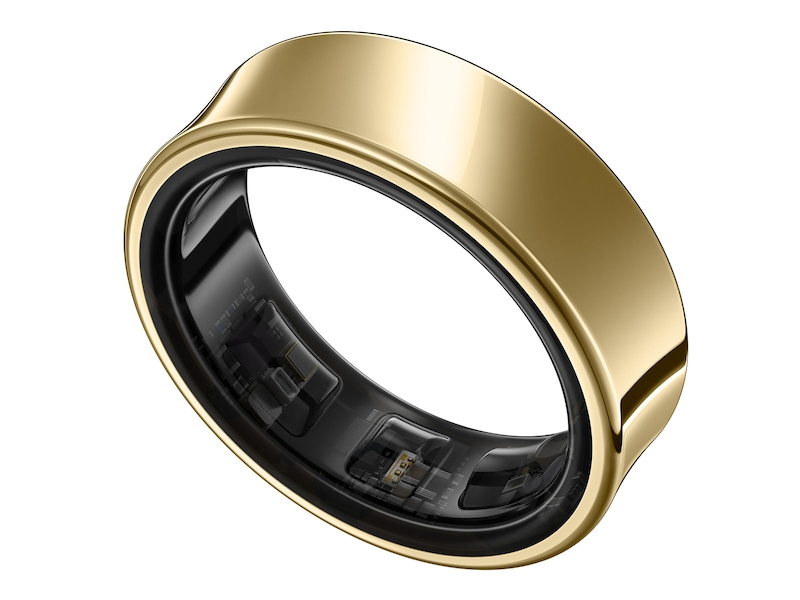
The launch of the Galaxy Ring marks a step in form factor diversification for Samsung, which seeks to expand its range of wearable devices. Rather than a standalone device, the ring positions itself as a passive biometric satellite, extending the centralized health dashboard powered by Samsung Health. The industrial goal is to capture continuous physiological data, particularly during sleep, by freeing users from the bulk and visual fatigue inherent in smartwatch screens. While the value proposition relies on discretion and simplified tracking, it raises an essential usage question: is the device a viable alternative to the Galaxy Watch or a mere luxury accessory for an already crowded ecosystem?
Miniaturization and Onboard Sensors
The engineering of the Galaxy Ring relies on high-density integration within a titanium chassis. Samsung housed three core sensors for metabolic and kinematic analysis:
- Accelerometer: Detects movement vectors for automatic identification of walking and running, without manual intervention.
- Optical Bio-signal Sensor (PPG): Measures heart rate. While effective at rest, it undergoes more aggressive algorithmic filtering during movement to compensate for the absence of mechanical tightening compared to a wristband.
- Skin Temperature Sensor: Analyzes overnight thermal variations to refine sleep scoring and menstrual cycle predictability (non-contraceptive use).
Beyond passive tracking, the ring incorporates active features via a double pinch gesture, allowing users to dismiss an alarm or trigger the camera on a Galaxy smartphone. Raw data is processed by Galaxy AI to generate an Energy Score, designed to evaluate physical readiness, alongside Wellness Tips. This technical sophistication nonetheless imposes strict logistical constraints to ensure measurement accuracy.
Ergonomics and Logistics: The Constraints of Electronic "Custom Fit"
For a wearable worn 24/7, stable contact between sensors and skin is the critical factor for reliability. Unlike traditional jewelry standards, the Samsung Sizing Kit is mandatory, as internal dimensions are altered by sensor bumps.
The logistical protocol is strict: after ordering, the user receives a free kit containing plastic samples (sizes 5 to 15, although larger sizes are frequently backordered). The user has 14 days after receiving the kit to confirm their size on their personal account, failing which the order is automatically canceled. A 24-hour test, including a full night to account for natural finger swelling, is imperative. The final ring, in titanium with a scratch-resistant concave finish, is available in Black, Silver, and Gold. However, this physical customization contrasts sharply with a marked software lock-in.
The Limits of the "Walled Garden"
Samsung maintains a strict ecosystem lock-in strategy. The Galaxy Ring requires a Samsung Galaxy smartphone running Android 11.0 or higher and a Samsung account. Incompatibility with iOS is complete and definitive. On other Android smartphones, the experience is either impossible or severely degraded according to technical feedback.
A point of friction emerges in Ring/Watch synergy: while Samsung Health is supposed to intelligently manage data when both devices are worn (prioritizing the watch for precision and saving energy on the ring), users report instances of duplicated data. This software mediation flaw can lead to contradictory or absurd analyses in the app. However, the inclusion of the Find My Ring feature allows users to locate the ring on a map if lost, a direct competitive advantage over third-party solutions.
Autonomy and Energy Management Analysis
Miniaturization imposes a physical ceiling on battery cells. While Samsung advertises battery life "up to 7 days," this performance is strictly reserved for sizes 12 and 13. Smaller sizes are technically limited to 6 days, or even less with heavy use.
Long-term user feedback is concerning: several users report premature degradation after 6 to 11 months, with battery life dropping below 24 hours. To limit chemical wear on the cells, the community recommends maintaining charge between 20% and 85%, a manual management burden for a device meant to be forgotten. The charging case, featuring an LED indicator and pairing button, remains the sole interface for energy maintenance.
Reliability and Customer Support: The Threat of Premature E-Waste
As a first-generation product, the Galaxy Ring presents structural vulnerabilities. Beyond Bluetooth disconnections, cases of swollen batteries have been documented, causing cracks in the titanium and raising safety concerns (potential combustion risks).
After-sales service is a major friction point. The device is non-repairable: any battery or sensor fault requires a complete unit replacement. Certain retailers (such as T-Mobile in the US) systematically refer customers back to Samsung, resulting in processing delays exceeding a month in some cases. Given this fragility, subscribing to Samsung Care+ is a near-mandatory precaution to protect this €450 investment. This risk of becoming "e-waste" after just one year of use is already fueling discussions around class action lawsuits in certain markets. By comparison, the Ultrahuman Ring AIR offers a similar experience for about €100 less, without exclusive software lock-in.
Our Take: Relevant Diversification or Simple Accessory?
The Galaxy Ring does not replace the Galaxy Watch; it redefines health tracking as a background activity. It excels at nocturnal and passive monitoring, offering a level of comfort that a watch cannot match. However, for a price tag of €450, users accept a product with an uncertain lifespan and limited active features.
Ideal User Profile: A Samsung Galaxy smartphone owner, already invested in Samsung Health, wishing to set aside their smartwatch without breaking data continuity, and accepting the financial risk inherent in a non-repairable first-generation technology. For the rest of the market, waiting for the maturity of the second generation seems to be the sensible choice.
Our Take: A promising piece of biometric technology for Samsung ecosystem enthusiasts, but one that stands to benefit from further maturity.