%20(1).png)
Smart Pet Feeders & AI: The Feline Nutrition Revolution in 2026
The New Era of Pet Tech & AI Nutrition
The pet smart home market has completed its evolution. In 2026, we are no longer discussing simple timer-based dispensers, but comprehensive connected health ecosystems. The objective is now purely analytical: biometrics and intake data (exact kibble consumption, hydration rates) serve as the foundation of modern preventive veterinary medicine, capable of detecting pathologies well before visible clinical symptoms appear.
Industry analysts identify a clear split between two distinct engineering philosophies:
- The Software-First vision of Petkit: Here, artificial intelligence and the mobile app are the core product. The brand relies on deep software integration and computer vision algorithms to drive pet wellness monitoring.
- The Mechanism-First resilience of Petlibro and Oneisall: For these manufacturers, pure mechanical feeding reliability takes absolute precedence. The goal is to guarantee meal delivery even if cloud servers stumble.
- The clinical vision of Petliv: Born from the veterinary supplement industry, this brand champions a 'Physiological Global Care' approach centered on hybrid stations balancing food and water hydration.
Connected ecosystems are now defined by interoperability: smart litter boxes, water fountains, and feeders communicate through a single dashboard to build a complete clinical profile of the animal. This intelligence relies on a centerpiece: computer vision.
AI & Microchip Recognition: Multi-Cat Management
For multi-cat households, individual identification is the holy grail. It converts passive feeding into active medical tracking, isolating the intake behavior of each individual cat without error.
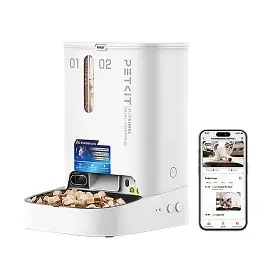
The Petkit YumShare Dual-hopper 2, recipient of the Microsoft AI Innovation Award at CES 2026, exemplifies software dominance. Using its HD camera, the appliance identifies each cat via facial recognition algorithms. This renders microchip RFID tags and specialized collars obsolete, which are often viewed as invasive or unreliable.
This technology reaches its full potential when paired with the Dual-hopper architecture. By managing two distinct kibble recipes in a single chassis, AI can dispense prescription veterinary food to Cat A while serving a standard recipe to Cat B. It is a domestic logistics revolution, even if, for Petkit, the camera remains the core component over raw mechanical force.
Wet Food Dispensing: Preservation Challenges
Wet food is vital for feline kidney health, but automating wet food delivery was long considered a hygiene nightmare. At CES 2026, Petkit broke this glass ceiling with the Yumshare Daily Feast.
This appliance robotizes wet food dispensing through two critical technological pillars:
- Vacuum Sealing Storage: Portions are preserved in an oxygen-free vacuum environment to halt oxidation.
- UVC Disinfection: Ultra-Violet C germicidal irradiation destroys micro-organism DNA, ensuring sterilisation of the internal dispensing chute—an absolute necessity for damp feeding safety.
The device promises up to 21 days of automated wet food operation with self-cleaning residual waste handling, raising automation to veterinary health standards.
Oneisall vs Petlibro: Mechanical Reliability
Faced with software complexity, raw mechanical reliability remains the ultimate safeguard for food security. The debate pits rich feature sets against guaranteed delivery.
Oneisall, with its PF09 model, emphasizes physical resilience: 16-inch bowl separation to prevent multi-pet aggression and heavy use of food-grade 304 stainless steel. Meanwhile, Petlibro evolved its Granary 2 line to accommodate larger pets.
A major technical distinction lies in kibble size tolerance:
- Oneisall and Petlibro (Granary 2): Support large kibble sizes up to 18 mm in diameter.
- Petkit: Imposes a stricter 12 mm limit, restricting recipe selection.
| Brand | Capacity | Max Kibble Size | Battery Type | Flagship Feature |
|---|---|---|---|---|
| Petkit | 5 Liters | 12 mm | Rechargeable (Camera disabled on backup) | AI Facial Recognition |
| Petlibro | 3 to 5 Liters | 18 mm | D-Cell Batteries | AI Motorized Lid |
| Oneisall | 5 Liters | 18 mm | D-Cell Batteries | Capacitor Memory |
Power Backup & Connectivity Resilience
In pet tech, a network outage must never result in starvation. Field stress tests conducted during winter storms in Columbus, Ohio revealed critical vulnerabilities in the 'Software-First' approach.
While Petlibro models excel at automatic reconnection after power grid flickers, Petkit's performance is more nuanced. According to official documentation, Petkit cameras automatically shut off in battery backup mode to conserve power. Consequently, during a power outage, owners lose all remote visual confirmation—a paradox for a product marketed around video reassurance.
Even more concerning, cloud reliance introduces software glitches. On Reddit, a YumShare user documented an erratic spree of 29 consecutive feedings. Notably, the user subscribed to the premium cloud tier and ran updated firmware, proving that premium fees do not grant immunity against cloud distribution bugs. Conversely, Oneisall integrates capacitor memory, preserving feeding schedules without Wi-Fi or backup batteries.
Our Verdict: Choosing Your Pet Feeding Ecosystem
Choosing a smart feeder in 2026 means selecting your philosophy between tech convenience and mechanical resilience.
- The Multi-Cat Tech Enthusiast: Petkit is the prime recommendation. Ideal for owners seeking granular AI tracking and individual profiling, accepting a degree of cloud dependency.
- The Rural Pragmatist: Petlibro or Oneisall are essential. Their 'Mechanism-First' design guarantees meals are served even during infrastructure collapse.
- The Global Health Household: Petliv is the logical recommendation. Its veterinary supplement heritage makes it the benchmark for complete physiological monitoring (weight, hydration, supplements).
BotCanConnect Advice: Watch out for hidden service costs. While live video streams are often free, historical health logs and cloud video storage are almost systematically locked behind recurring monthly subscriptions—an ongoing cost factor to consider prior to purchase.