
%20(1).png)
Dry Air and Thermal Comfort: Philips Humidification Series 3000 vs 5000 Comparison
The Importance of Indoor Humidity: Beyond Simple Comfort
Maintaining a balanced humidity level within the home is a strategic variable for environmental health. Air that is too dry, common during intensive heating in winter, promotes skin dryness, respiratory tract irritation, and static electricity. Conversely, excessive humidity can degrade woodwork and foster mold growth. Philips specifications align with health standards by recommending adjustable operating thresholds between 30% and 70% relative humidity. The choice of a humidifier should therefore not be left to chance; it requires a technology capable of saturating the air homogeneously without compromising the hygiene of the inspired air. It is in this field that Philips developed NanoCloud technology, a clear break from traditional ultrasonic systems.
NanoCloud Technology: Analysis of a Breakthrough in Humidification
Unlike ultrasonic humidifiers that project visible water droplets, NanoCloud technology relies on the principle of natural evaporation. This technical paradigm shift brings critical advantages in terms of sanitary safety.
The superiority of NanoCloud lies in the physics of the generated water molecule: water vapor molecules are about 1,000 times smaller than those produced by classic misting. At this microscopic scale, it is physically impossible for bacteria and minerals to attach to water molecules and be carried into the air. This physical barrier results in a 99% reduction in bacterial spread. As a result, the user avoids white dust formation (mineral deposits) and wet spots on furniture. This invisible vapor ensures 360° multidirectional distribution without local saturation, a technology that forms the foundation of the Series 3000.
Series 3000: Balance Between Compactness and Performance
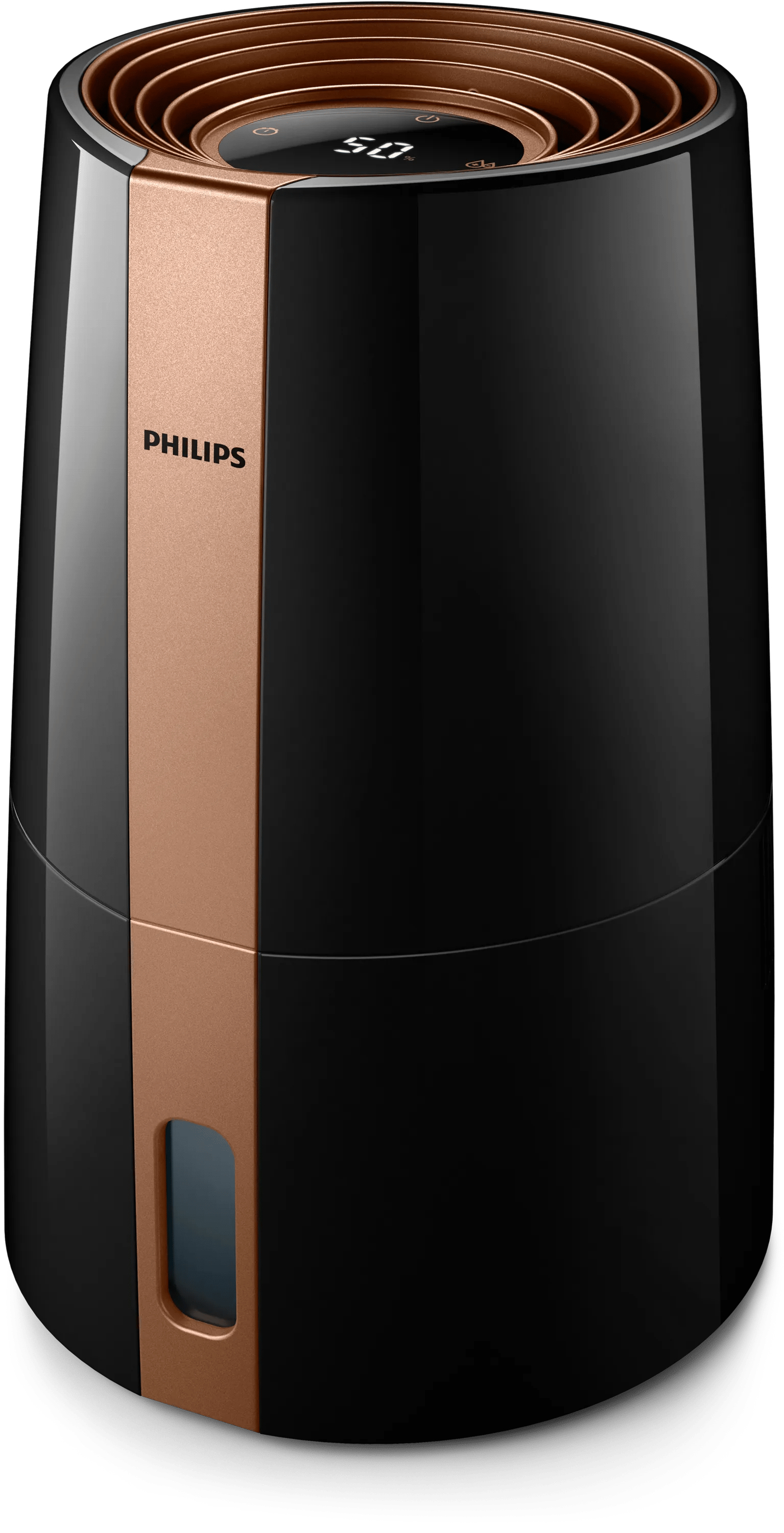
The Series 3000 represents the core of the Philips range, targeting bedrooms and workspaces. It comes in two models with very different flow performances:
- HU3916: A dedicated humidification model covering 45 m². It features a 3 L tank for a output of 300 ml/h. Its electrical consumption is kept at 25 W.
- AC3829/60 (Series 3000i): A 2-in-1 hybrid solution combining purification (HEPA NanoProtect filter) and humidification. This model is significantly more powerful with a flow of 600 ml/h and a 4 L tank capacity, allowing it to treat rooms up to 80 m².
User tests confirm the accuracy of the AeraSense sensor, which analyzes air quality in real-time. On the acoustic side, these models benefit from Quiet Mark certification with a noise level of 33 dB in night mode, ensuring essential discretion for sleep. This range lays the groundwork for efficiency before giving way to the smart versatility of the Series 5000.
Series 5000 (HU5710): Connected Experience and Aromatherapy
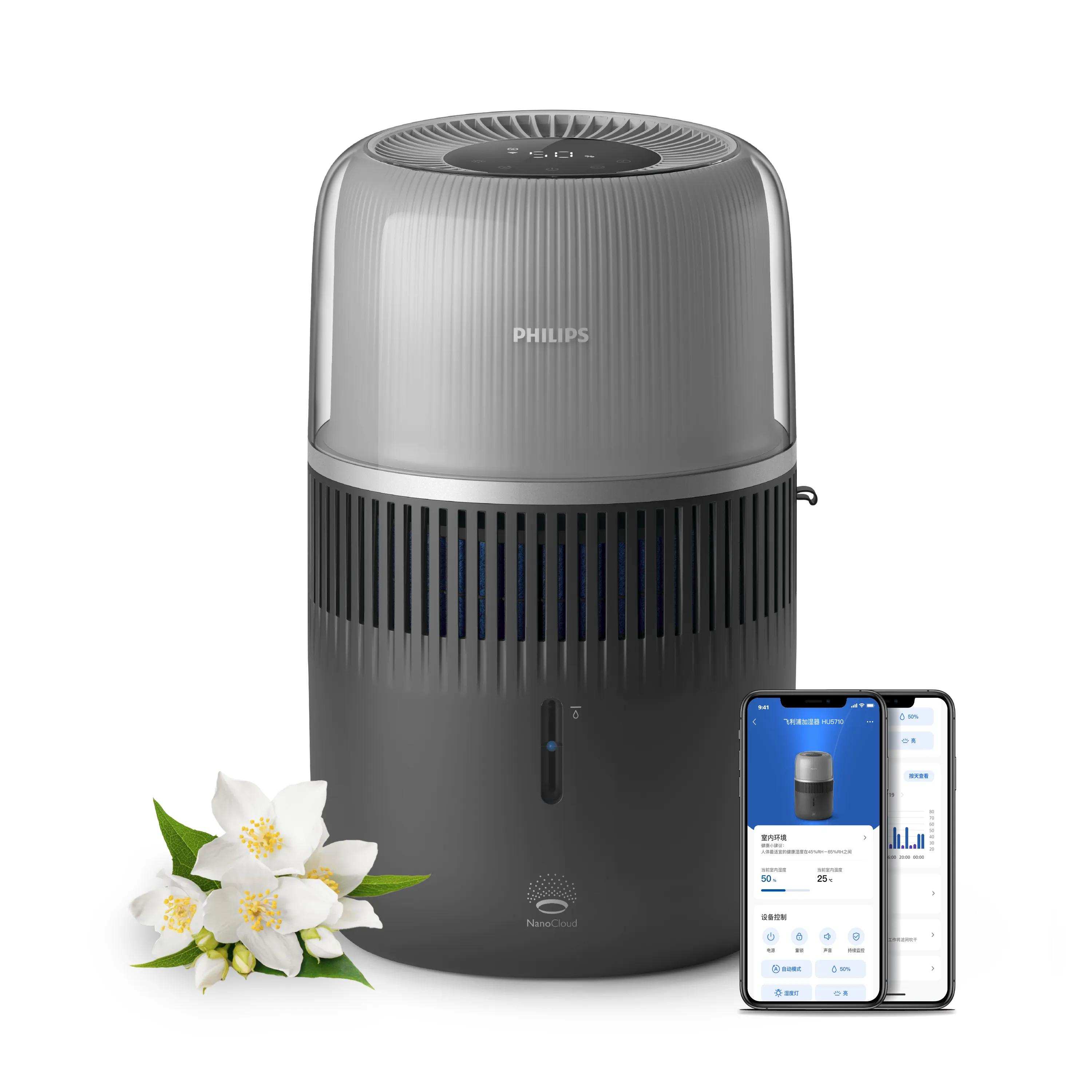
The HU5710 model positions the Series 5000 in the premium segment, focusing on automation and sensory well-being. Designed for areas up to 56 m², it has a output of 400 ml/h.
Energy efficiency is first-rate: even at its highest setting, the device consumes only 8 W (up to 14.1 W depending on modes), equivalent to a LED bulb. Its 4.5 L XL tank allows a record runtime of 37 hours. Philips introduces the QuickDry mode on this model, which uses a sensor and the fan to dry the filter once humidification is complete, preventing microbial growth.
The added value also lies in the aromatherapy function via dedicated pads (reference FY5100) and adjustable ambient lighting. Home automation integration is total via the Air+ application, compatible with Google Assistant and Amazon Alexa. Note, however, a minor point identified by Stiftung Warentest: some reports of loose contacts during assembly which may require careful repositioning of parts for optimal operation.
Comparative Summary of Technical Specifications
The global coherence of the Philips ecosystem relies on its technological integration and reliability.
| Specifications | Series 3000 (HU3916) | Series 3000i (AC3829/60) | Series 5000 (HU5710) |
|---|---|---|---|
| Covered area | 45 m² | 80 m² | 56 m² |
| Humidification flow | 300 ml/h | 600 ml/h | 400 ml/h |
| Tank capacity | 3 L | 4 L | 4.5 L |
| Minimum noise level | 33 dB | Ultra-silent sleep mode | 12 dB |
| Maximum consumption | 25 W | 45 W | 14.1 W |
| Connectivity | None | Wi-Fi (CleanHome+) | Wi-Fi (Air+) |
Performance-to-price analysis favors the Series 5000 for users seeking ergonomics and long-term energy savings. The HU5710 obtained a score of 96/100 in the Haus & Garten Test, praising its ease of use and efficiency.
Maintenance Guide and Troubleshooting of Common Issues
The durability of a humidifier depends on the maintenance, especially in hard water areas. Mineral buildup is the leading cause of breakdown or performance drop.
Here are the solutions to issues identified by technicians:
- No visible vapor: Normal operation of NanoCloud. The vapor is molecular and therefore invisible. It does not wet surfaces.
- Unpleasant odors: Sign of stagnant water. Weekly cleaning with white vinegar is mandatory. For descaling, soak for 30 minutes in a solution of water and white vinegar before rinsing thoroughly.
- Excessive noise: Check the stability of the support and the correct assembly of internal components.
Humidification filters (wicks) like FY3435 for the Series 3000 or FY5030 for the Series 5000 have an average lifespan of 6 months depending on usage.
Our Take: Which Model to Choose for Your Needs?
The choice between these two series depends on your environment and your level of tech requirement.
The Series 3000 is recommended for bedrooms due to its low noise level. The AC3829 hybrid model is the logical choice for those who want to centralize air treatment (purification + humidification) in a single powerful unit capable of handling large volumes up to 80 m².
The Series 5000 is intended for users who want an advanced connected home experience. Its extended autonomy and QuickDry mode make it the most hygienic model in the range. It is the ideal investment for a main living area where design and wellness functions (aromatherapy, lighting) are primary.