
%20(1).png)
Air Performer and Series 8000: Is Philips Shaking Up the Air Treatment Hierarchy?
Philips Air Performer 8000 (AMF870): Analysis of a Versatile Flagship
In an architectural context where thermal insulation and building airtightness are becoming the norm, indoor air management has turned into a major environmental engineering challenge. The confinement of pollutants now demands a versatility that classic purifiers struggle to offer. The Philips Air Performer Series 8000 (AMF870/15) attempts to address this issue with an "all-in-one" approach: purification, heating, and ventilation.
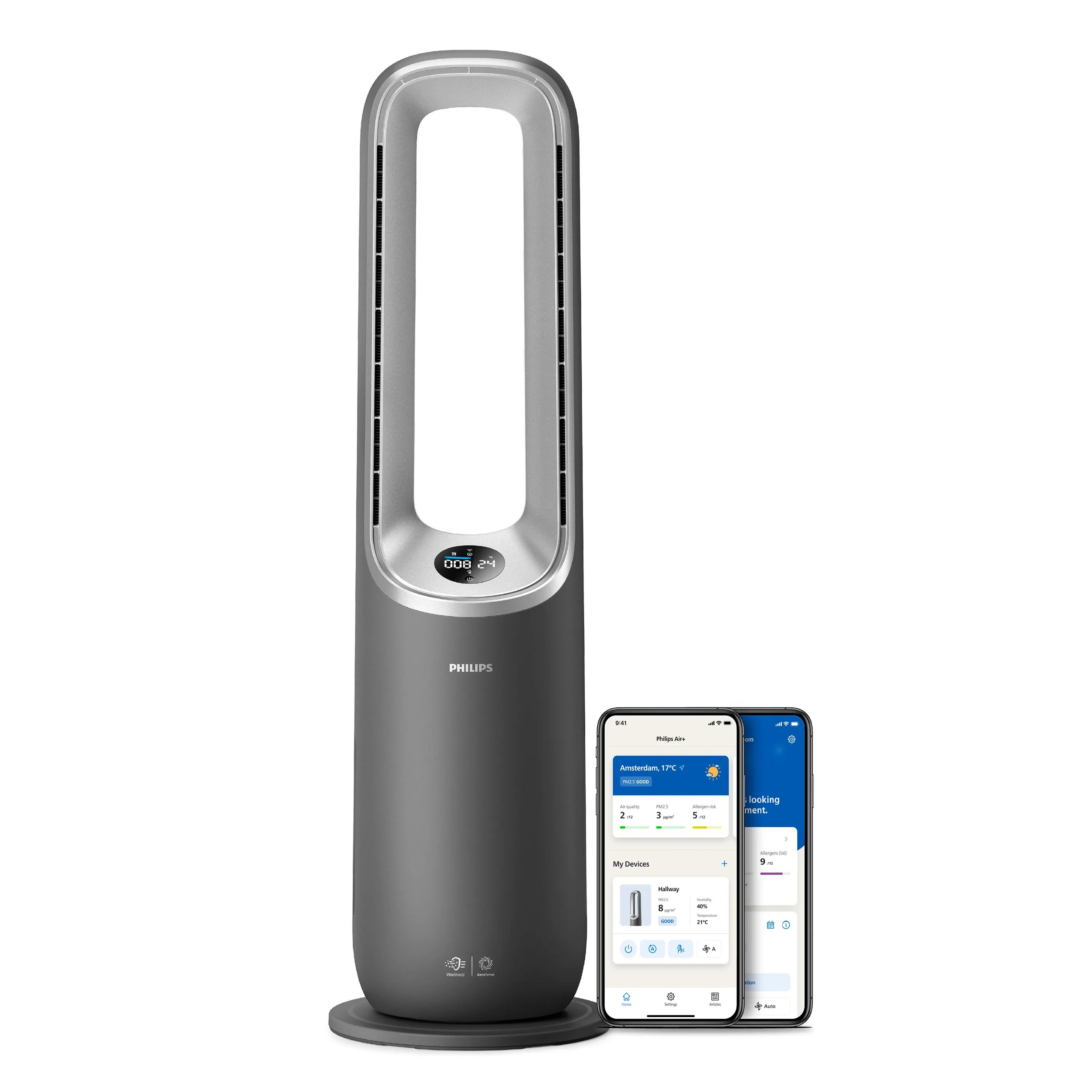
On the technical side, the AMF870 stands out with its bladeless design, generating a continuous laminar airflow capable of treating volumes up to 70 m². The main advantage of this flagship lies in its PTC (Positive Temperature Coefficient) ceramic heating element, which reaches the set temperature in just 3 seconds. For the user, this means instant heat, eliminating the thermal inertia of oil-filled radiators. However, the senior editor will note that this formal elegance hides some ergonomic shortcomings: a physical interface on top of the device with unclear icons, and some software latency when switching modes, the device sometimes being "slow to respond."
This seasonal versatility, while appealing, remains dependent on the rigor of its filtration chain.
Filtration Performance: Beyond Marketing Promises
For the BotCanConnect department, the CADR (Clean Air Delivery Rate) remains the sole benchmark. Philips here announces a triple-layer system (pre-filter, HEPA filter, and activated carbon) capable of capturing 99.97% of particles as small as 0.003 micrometers. Concretely, this filtration fineness targets not only dust but also pathogenic aerosols, viruses, and volatile organic compounds (VOCs) from adhesives or paints.
Usage tests confirm real effectiveness on persistent cooking odors (pan frying) and a notable reduction in morning allergy symptoms. One technical point deserves attention: while the AMF870 allows pollution visualization via a PM2.5 light ring, Philips historically relies on infrared sensors, which are inherently less accurate than the laser sensors found in the Xiaomi range. To compensate, the device offers intelligent segmentation via three specific Auto modes: "Pollution," "Allergens," and "Bacteria & Viruses," allowing the capture strategy to be refined based on the detected environmental risk.
This processing power is closely controlled by a software ecosystem that transforms the device into a true climate station.
The Connected Ecosystem: The Air+ App in Daily Use
Often perceived as a gimmick, connectivity here takes on its full meaning. The Air+ app is not limited to remote control or Alexa compatibility; it serves as a historical analysis center for air quality. The Auto+ function proves particularly relevant: it adjusts power based on outdoor and indoor pollution peaks, thus optimizing filter longevity.
The main benefit of the app is to compensate for the sometimes confusing physical ergonomics of the device. It allows direct access to "Bacteria & Viruses" modes without navigating unintuitive physical menus. However, this reliance on software underscores Philips' position: a device designed to be automated and forgotten, rather than manually operated.
Strategic Comparison: Philips vs. Dyson and Xiaomi
Philips positions itself as a "rational high-end" alternative. It avoids the premium cost of Dyson's design while offering superior technical features compared to entry-level models like Xiaomi.
| Criterion | Philips AMF870 (Series 8000) | Dyson Pure Cool Link (TP02) | Xiaomi Mi Air 2S |
|---|---|---|---|
| Functions | 3-in-1 (Heat, Fan, Purify) | 2-in-1 (Fan, Purify) | Purification only |
| Max Area | 70 m² | 43 m² | 37 m² |
| Min Noise | 19 dB | 23 dB (night mode) | 31 dB |
| Max Noise | 46-50 dB | 63 dB | 60+ dB |
| Max Power | 2200 W (heating) | 56 W | 31 W |
| Street Price | Balanced Premium | Very High | Entry level |
In short: While Xiaomi offers the best CADR-to-price ratio, it is noisy and basic. The Dyson TP02, though iconic, features less strict filtration and reaches 63 dB at full power, whereas the Philips remains much quieter. Philips wins on acoustics and versatility, but this performance comes with a cost.
Maintenance and Hidden Costs: The Editorial Verdict
A technological investment is judged by its durability. First downside: mobility. Weighing 8 kg and lacking any wheels, the AMF870 is laborious to move between rooms, despite its stable base.
Operating cost is also a major differentiating factor. In heating mode, the 2200 W consumption is comparable to adding a second water heater to your electricity bill; sparing use as a supplement is therefore imperative. On the maintenance side, the price of Philips replacement filters is about double that of Xiaomi's, increasing the annual cost of ownership.
Our verdict: With an average rating of 4.3/5 based on over 700 user reviews, the Philips Series 8000 establishes itself as a safe bet for allergy-prone households. It is a serious piece of engineering, exemplary in silence (19 dB in night mode, making it imperceptible). We unreservedly recommend it for its high-end purification, while advising the use of the app to bypass a less-than-perfect physical interface and prudent management of the heating mode to preserve your energy budget.