
%20(1).png)
Complete Guide to Philips Hue Lightstrip Ranges
Standard Evolution: The Advent of the Hue Flux Range
Signify is currently making a major strategic shift with its Philips Hue brand: abandoning "Solo" (monochrome) lightstrips and the "Lightstrip Plus" in favor of gradient technology, now established as the new standard. This democratization of RGBIC technology completely redefines the entry-level segment. Under the name "Standard Re-imagined", the Hue Flux model integrates features once reserved for the premium segment, effectively phasing out old references in favor of a single, versatile solution.
On the technical side, the evolution is surgical. Shifting from a LED spacing of 5.5 cm to just 2.75 cm on the Flux model radically changes the experience: this higher density eliminates hot spots for homogeneous light diffusion. For the installer, however, the nuance is crucial: while the 3m model consumes 12 W, brightness caps at 2000 lumens starting with the 5m model. Stepping up to a 10m version will not bring any raw power gains, but simply extended coverage. The intelligence of this range also lies in its durability: new connectors finally allow reusing cut segments, optimizing every centimeter of lightstrip.
Visual Excellence: The Hue OmniGlow Range

The OmniGlow is no longer an accessory to hide, but a central architectural element. Its fundamental difference from the Flux range lies in its matte silicone sheath (compared to a transparent sheath for the Flux), offering a continuous and organic line of light, without any visual hot spots.
Technically, the OmniGlow relies on CSP (Chip-Scale-Package) micro-LEDs and Chromasync technology. The latter ensures total color accuracy, essential for demanding environments. With output reaching 6000 lumens and unmatched fluid effects, it is the reference lightstrip for direct design.
Cramer, field reality is less flattering regarding installation. The original adhesive lacks strength, often forcing installers to use solutions like Tesa Powerbond for a lasting ceiling mount. Even more annoying, the protective film of the adhesive is segmented every 20 cm: a real ergonomic failure that requires peeling dozens of small bands over long lengths. For a product claiming to be premium, this lack of care is hard to justify.
Power and Architecture: The Flux Ultra Bright Variant
The Ultra Bright version occupies the top of the hierarchy in terms of light output. Designed for wall-washing and monumental coves, it is capable of replacing main lighting in large volumes.
Its specifications leave no doubt about its purpose:
- Consumption: 29 W to ensure constant intensity.
- Performance: Up to 6000 lumens on the 10-meter version (not to be confused with the 2000 lm of the standard Flux).
- Design: Unlike the OmniGlow, the lightstrip uses a transparent sheath, making the LEDs visible.
What this means for the installer: the Ultra Bright must be hidden. Its use is strictly limited to indirect lighting where only reflective power counts. It is the ideal tool for wall-washing or lighting cathedral ceilings where other models would fall short.
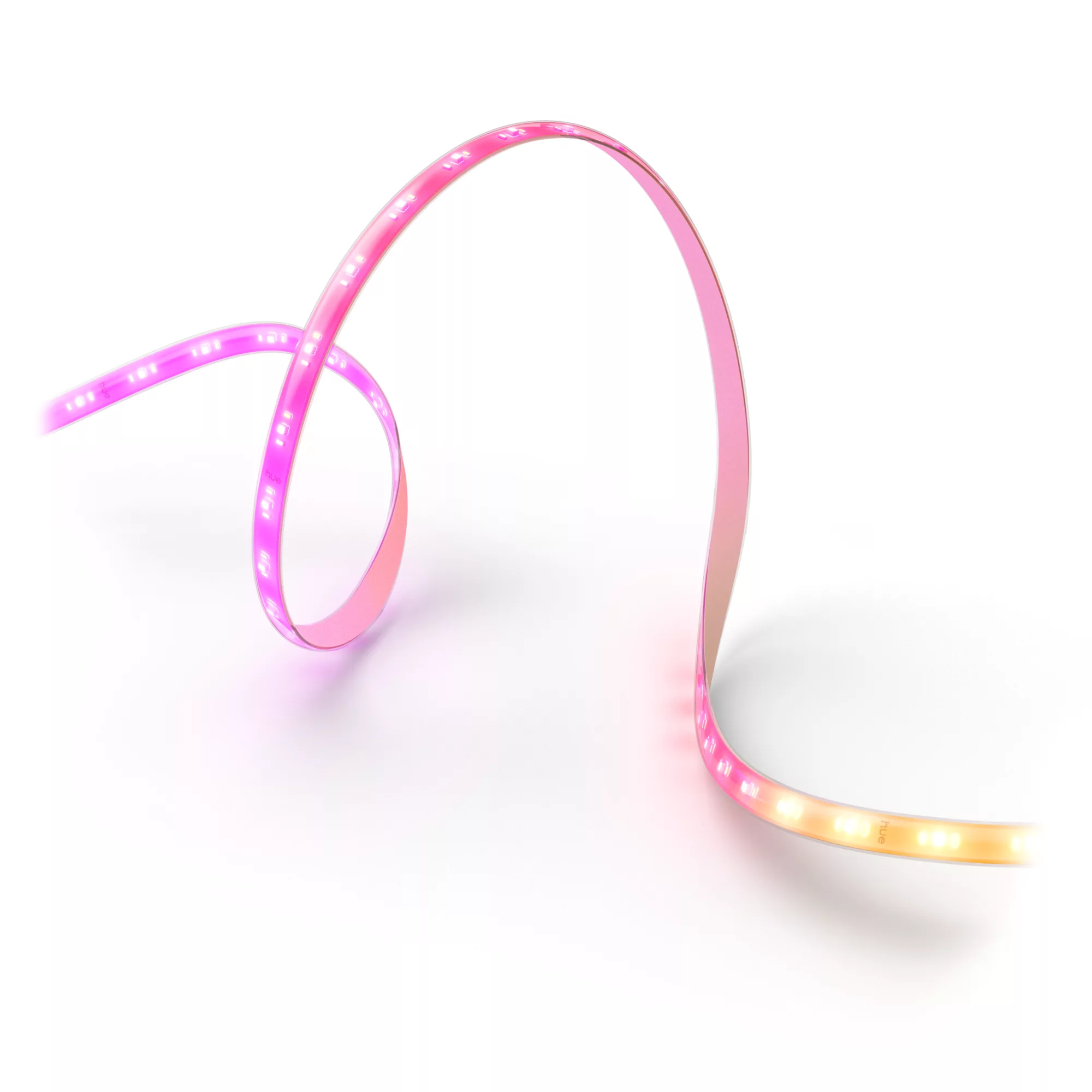
Resilience and Outdoor Aesthetics: Outdoor and Neon Ranges
For outdoors, Philips Hue offers two IP67-certified approaches. The Flux Outdoor lightstrip targets classic diffusion for pathways, while the Neon Gradient Outdoor proposes the look of a high-resistance neon tube.
The Neon model displays a modest brightness of 1100 lumens for 500 cm. This value, much lower than indoor models, is explained by the physical constraints of the thick silicone cladding necessary to ensure both flow homogeneity and UV/weather resistance. Note a critical limitation: this lightstrip is non-cuttable. A measurement error at ordering is fatal, as no adaptation is possible on site.
Technical Overview
The global coherence of the Philips Hue ecosystem relies on its integration: Zigbee protocols, Bridge Pro, and now Matter. This interoperability, coupled with software functions like MotionAware (smart zone management), ensures the sustainability of the investment compared to less stable proprietary solutions.
| Range | Primary Use | Max Brightness | Key Strengths | Limitations |
|---|---|---|---|---|
| Hue Flux | Versatile / Indirect | 2000 lm (depends on length) | Value for money, cuttable | Visible LEDs if direct |
| OmniGlow | Design / Direct | 6000 lm | Perfect diffusion, Chromasync | Weak adhesive, segmented liner |
| Ultra Bright | Architectural | 6000 lm | Raw power (Wall-washing) | Visible LEDs (transparent sheath) |
| Neon Outdoor | Outdoor Marking | 1100 lm | Homogeneous neon look, IP67 | Non-cuttable, limited flux |
Our Verdict: What Strategy to Adopt?
- The Beginner: Prefer the Hue Flux. It is the new benchmark for home gradient lighting, offering the best compromise between cost and features.
- The Design Enthusiast: OmniGlow is a must for any installation where the lightstrip is visible. Its CSP rendering is exceptional, though it requires extra care (and additional adhesive) during installation.
- The Pro Installer: To optimize your budgets, leverage the new flexible connectors (90°, 50cm) of the Flux system that allow reusing every single scrap. For critical areas, combine the Ultra Bright in the cove for general flow and the Linear Gradient for a kitchen with no compromise on white clarity.