
%20(1).png)
Dual-Basket Air Fryers: Evolution Toward Versatility and Space Optimization
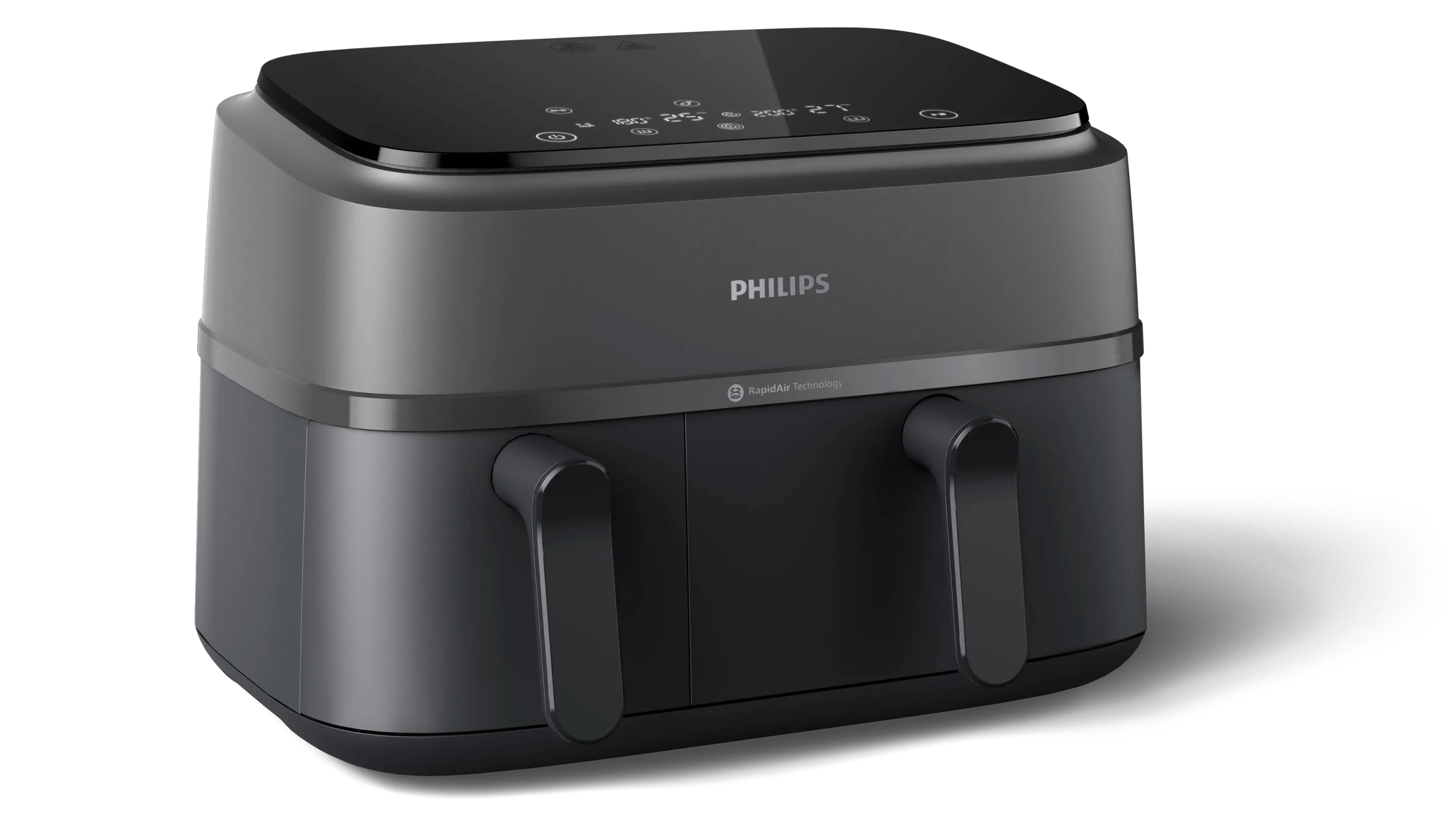
The air fryer market is undergoing a phase of technological maturity marked by the progressive shift from single-drawer units to dual-compartment architectures. Innovation is no longer limited to basic oil-free convection; it now centers on the simultaneous thermal management of independent heat flows and the drastic optimization of countertop footprint. This transformation turns the air fryer into a central cooking station capable of managing heterogeneous dishes with surgical precision while fitting the tight space constraints of modern kitchens.
Technical Architecture: From Simple Convection to Zone Management
The thermal efficiency of an air fryer depends on its ability to generate high-velocity forced convection within a compact volume. This fluid dynamics engineering dictates the kinetics of the Maillard Reaction, ensuring exogenous crispness while preserving endogenous cellular moisture.
- Anatomy of Performance: RapidAir Plus technology utilizes a bottom cavity geometry shaped like a "starfish." This patented design does not merely reflect air; it creates a thermal vortex that forces hot airflow to circulate not only around, but directly through food items. On premium models, this airflow moves up to seven times faster than flat-bottom architectures, delivering critical cooking uniformity for dense food loads.
- Algorithms and Sensors: Differentiating product tiers, Smart Sensing technology equips premium models like the HD9860 (XXL Premium). It uses sensors to automatically adjust time and temperature mid-cycle. For dual-basket models (Series 3000 and 5000), control relies on Smart Chef programs and software synchronization functions that optimize parameters based on the selected ingredient type.
- Fat Separation: Fat Removal technology harnesses centrifugal airflow force to isolate and capture excess saturated fats. Technical tests on the Premium model confirm extraction of up to 50% of fat based on three raw chicken thighs cooked at 180°C (356°F) for 24 minutes.
This precise airflow mastery allows modern units to thermally isolate two distinct zones without pressure loss, clearing the path for diverse industrial formats.
The Format Duel: Side-by-Side vs. "Stacked" (Vertical)
Countertop clutter has become the primary barrier to adopting large-capacity models. Industrial design solves this dilemma through two distinct approaches: horizontal expansion or vertical stacking.
- Vertical Innovation: Pioneered by Ninja in 2024, the "Stacked" (superimposed) format redefines compactness. The Philips 4000 Series Stacked (NA462) model utilizes Vertical RapidAir Technology to maintain full cooking performance while achieving a 45% reduction in countertop footprint compared to traditional brand models.
- Capacity and Volume: The vertical format requires no volumetric compromise. The NA462 boasts a 10L capacity (2x5L), allowing users to roast two 1.2 kg chickens simultaneously. By comparison, the Cosori Turbo Tower offers 8.6L, while the horizontal Ninja Double Stack standard (SL300UK) sits at 7.6L.
- Sync and Match Functions: DualZone management allows the Sync function to coordinate two cooking cycles with opposing parameters (temperature/duration) for a synchronized finish time. The Match function instantly duplicates settings from one basket to the other for batch cooking.
| Architectural Style | Benchmark Model | Key Advantage | Typical Capacity |
|---|---|---|---|
| Vertical / Stacked | Philips 4000 Series (NA462) | Space saving (-45% footprint) | 10L (5L + 5L) |
| Side-by-side | Philips 3000 Dual Basket | Accessibility & ergonomics | 9L (6L + 3L) |
| Double Stack | Ninja Double Stack (SL300UK) | Compact design & included racks | 7.6L (Total) |
| Turbo Tower | Cosori Turbo Tower | Optimized touch interface | 8.6L (Total) |
Beyond physical form factors, the integration of new thermal vectors like steam marks the true technological breakthrough.
Cooking Mode Hybridization: Steam Integration
Introducing controlled moisture into a dry frying system radically alters organoleptic results. This strategic hybridization makes it possible to prepare delicate foods previously ill-suited for air fryers.
- Air Steam Technology: The Steam Airfryer Series 5000 (NA555) introduces three operational modes: Airfry (convection only), Steam (steam only), and Steamfry. The latter combines both technologies to saturate the cavity with moisture before the crisping phase, preventing protein drying.
- Nutritional Integrity: Independent laboratory measurements show that steam cooking preserves up to 87% of Vitamin C in broccoli, compared to boiling which causes massive nutrient leaching.
- Software Versatility: These units feature up to 19 pre-programmed cooking modes: steam, steamfry, reheat (perfect for rice or lasagna without drying out), bake, grill, roast, and dough proofing. Ergonomics are enhanced by the EasySlide Rail system (on Series 5000), a sliding rail mechanism ensuring smooth stability and safety when extracting heavy loaded baskets.
This hardware complexity, including water tanks and mechanical rails, demands rigorous maintenance to preserve energy efficiency.
Maintenance, Safety, and Energy Efficiency
Air fryer efficiency is its main economic selling point over traditional ovens, but it depends directly on heating element cleanliness and power management.
- Energy Performance: To maintain stable temperatures across two simultaneous chambers, dual-basket models like the Philips NA555 or NA462 feature a peak power rating of 2750W. Despite this high wattage, the unit cooks up to 40% faster than a standard oven. Internal Philips testing on sausage cooking demonstrates energy savings of up to 80% compared to a Class A oven.
- Safety and Installation: Kitchen recommendations from GreenPan advise installing units on flat, heat-resistant surfaces with several centimeters of peripheral clearance for air vents. Using non-metallic utensils is imperative to preserve non-stick coating integrity.
- Hygiene and SteamClean: Daily maintenance prevents carbonized residue buildup that causes smoke. Modern coatings are certified PFAS-free (often ceramic-based). The Auto SteamClean feature simplifies cleaning by using steam to soften baked-on grease around the element, complementing dishwasher-safe removable parts.
Ongoing maintenance is the essential prerequisite to protect the technological investment represented by dual-basket units.
Our Verdict: Dual-Basket Air Fryers
Technical analysis confirms that the dual-basket format is not a mere marketing gimmick, but a structural response to family productivity and healthy cooking needs.
- Technical Verdict: Dual compartments offer indispensable flexibility for complete meals. The "Stacked" format definitively solves the capacity-versus-footprint dilemma, while steam hybridization (Steamfry) eliminates the historic drawback of the category: excessive moisture loss.
- Limitations: Peak electrical draw (2750W) requires suitable kitchen circuits, and the variety of modes may require an initial learning curve.
Strategic Buyer Criteria:
- Capacity: 9L to 10L (e.g., Philips NA462/NA555) for households of 4 or more people.
- Space: Vertical "Stacked" format is imperative if countertop surface is under 0.5 m².
- Nutrition: Prioritize models with steam technology for vitamin preservation and superior reheating of leftovers.
- Ergonomics: Look for sliding rails (such as EasySlide) and viewing windows to prevent unnecessary basket openings during cycles.
Integrating IoT ecosystems like the HomeID app transforms these appliances into connected culinary assistants, guiding users toward increasingly refined automation of home cooking processes.
Our Take: The dual-basket format (especially in vertical stacked configurations like the Philips NA462) represents the ultimate solution for families seeking speed and space savings without compromising cooking quality.